If you’re a business owner who’s been putting off video, you’re not alone. Video marketing for small business has become one of the most powerful tools for building trust and generating leads online — but most people never get started because they hate how they look and sound on camera.
Here’s the truth: you don’t suck at content creation. You’ve never been taught how to make it feel natural. There’s a difference.
I’ve been creating video content and helping businesses with multimedia for over 15 years. In that time, I’ve worked with business owners across industries on their video content strategy, and I can tell you that being “good on camera” isn’t a personality trait — it’s a skill. And it’s a skill anybody can learn with the right approach.
Here’s everything I’ve learned about looking natural, sounding confident, and actually connecting with your audience through video — without turning into a robot or losing your personality in the process.
1. Stop Memorizing Your Script
This is the single biggest mistake people make, and it’s the fastest way to sound like you’re reading off a teleprompter in your head.
Instead of memorizing your script word for word, memorize the key points of each section. Think of them as beats, not lines. For example, if you’re filming a video about your services, your beat might be “the problem most business owners face.” You know what that problem is. You talk about it all the time. Let the specific words come out naturally.
Read your script out loud five or six times before you film — not to memorize it, but to get the ideas into your head so they feel like your own thoughts. By the fifth read-through, you’ll start naturally rephrasing things in your own voice. That’s the version you want on camera.
2. Talk to One Person, Not a Lens
Here’s the mental trick that changes everything — and one of the most underrated on camera tips you’ll ever hear.
Don’t talk to a camera. Talk to one specific person. Picture a past client, a friend who keeps asking you for advice, or that buddy who’s been complaining about his terrible website for six months. Imagine their face right behind the lens.
When you’re explaining something on camera, you’re not presenting to an audience — you’re having a conversation with that one person. That mental shift turns “performing for a camera” into “talking to a friend,” and the difference is immediately visible. Your face relaxes, your voice sounds natural, and your personality actually comes through.
3. Set Up Your Space Like a Real Human
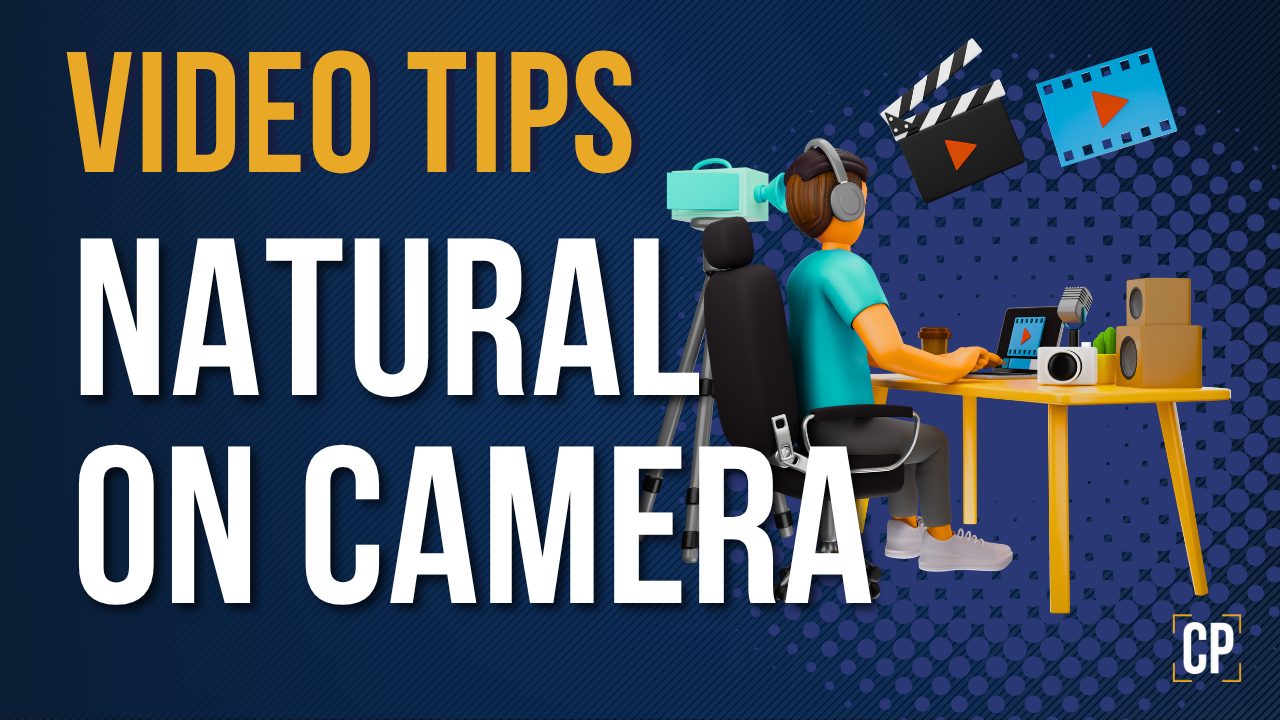
Film at your actual desk or workspace. Not a blank wall, not a green screen, not some staged setup that looks nothing like your real life. A laptop, a second monitor, maybe a coffee mug in the background — that’s your set.
People want to see that you’re a real person who does real work. An overly polished studio setup can actually work against you if your brand is built on being approachable and hands-on. For small business marketing, authenticity almost always outperforms polish.
Camera Positioning
Place it at eye level and slightly closer than you think is comfortable — about the distance of a FaceTime call. This creates the feeling of a one-on-one conversation, which is exactly what a good business video should feel like.
Lighting
Natural light from a window in front of you beats any ring light. If you’re filming at night or in a dark room, one soft light source slightly above and in front of you works.
⚠️ Avoid overhead fluorescent lights — they make everyone look like they haven’t slept in three days.
4. Film in Sections, Not One Take
Do not try to nail a two-minute video in one continuous take. That’s a recipe for frustration and stiff delivery — and one of the most common things I see derail content creation for entrepreneurs who are just getting started.
Break your script into sections and film each one separately:
- Your intro is one clip
- Your main point is another
- Your call to action is another
Give each section three to five takes. Here’s a pattern you’ll notice every single time:
- Take 1: Too stiff — you’re warming up
- Takes 3–4: The sweet spot — warmed up but still fresh ✅
- Last take: Too tired — you’ve overthought it
That middle range is the one you’ll use.
5. What to Do Before You Hit Record
Before your first real take, record yourself talking about literally anything for 60 seconds. What you had for lunch. Something that annoyed you today. A show you’ve been watching. Then delete it.
This warmup burns off the initial awkwardness so your first real take isn’t carrying all that nervous energy. It sounds silly, but it works every single time.
Also, before each section:
- Take a breath
- Consciously drop your shoulders (they creep up when you’re tense)
- Start talking half a second before you feel “ready”
That last one eliminates the stiff “okay, here we go” face that shows up at the beginning of almost every take.
6. How to Be Confident on Camera With Your Voice
A few vocal adjustments make a massive difference in how you come across. These business video tips alone can change how people perceive your authority the moment you start speaking.
Drop Your Pitch Slightly
When people get nervous on camera, their voice goes up. Consciously lower it about 10%. Think “talking to someone across a table at a restaurant” — not “presenting to a room.”
Vary Your Speed
When you hit an important point, slow down a little to let it land. When you’re listing things or building energy, speed up slightly. Monotone delivery is the death of engagement — your natural speaking voice already has this variation built in, you just need to stop suppressing it.
End Statements Going Down, Not Up
This is the single biggest difference between sounding confident and sounding uncertain when speaking on camera.
Going up at the end of a sentence sounds like you’re asking a question or asking for permission. Going down sounds like a statement of fact.
Practice saying “That’s what we do” with your voice going down at the end. Then say it going up. Hear the difference? One sounds like a professional. The other sounds like someone who isn’t sure.
7. Use Your Hands
If you naturally gesture when you talk, do it on camera. Keeping your hands still or pinned to your sides makes your whole body tense up and your face goes flat.
Hands moving means energy moving, and energy is what keeps people watching. You’re not giving a formal speech — you’re having a conversation. Let your body act like it.
8. Mistakes Are Features, Not Bugs
When you stumble over a word — and you will — don’t stop recording. Pause, take a breath, and restart that sentence. You’re editing this anyway. The pause gives you a clean cut point in post-production.
Here’s what most people don’t realize: some “mistakes” actually make your video better. A small stumble followed by a quick laugh or “let me say that differently” makes you more relatable, not less.
You’re not a news anchor. You’re a real person talking to real people about real problems. A little imperfection builds trust faster than a polished performance ever could.
This is especially true when it comes to video marketing for small business — your audience isn’t expecting a TV commercial. They’re expecting a human.
Your Pre-Record Checklist
Before you film your next business video, run through this list:
- Read the script out loud five times (don’t memorize — internalize)
- Picture one specific person behind the camera
- Film at your real workspace with natural light
- Do a 60-second warmup recording (then delete it)
- Film each section separately, three to five takes each
- Use your hands and let your body move naturally
- Drop your vocal pitch about 10%
- End statements going down, not up
- When you mess up, pause and restart the sentence — don’t stop recording
- Your best take is usually take three or four
The Real Secret to Confident Video Content
The best business videos aren’t the most polished ones. They’re the ones where the person on camera is clearly being themselves — slightly imperfect, genuinely helpful, and obviously passionate about what they do.
If you’re a business owner who’s been avoiding video because you think you’re “not good on camera,” you’re probably closer to great than you think. You already know your stuff. You already care about your customers. You already talk about your work every single day.
The camera isn’t something new to be afraid of. It’s an opportunity to show people what they’d experience if they actually worked with you. And if that experience is genuine, helpful, and human — that’s all the video needs to be.
A smart video content strategy doesn’t start with fancy equipment or a production crew. It starts with you, being real, showing up consistently, and letting your expertise do the talking.
Chris Peter is the founder of Chris Peter Media LLC, a multimedia creative brand helping local service businesses build professional websites, lead systems, and online foundations that actually work. With 15 years in design, video production, and digital marketing, he works directly with business owners who want real results without the agency runaround.